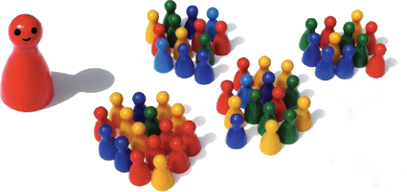
Fiction based personas

Articleed | | Personas (UK), Resources.

Most agree that personas are built on data, but several have experimented with purely fiction-based personas. These personas are often used to explore design and generate discussion and insights in the field. There are several suggestions to use fiction, here are a couple of links for inspiration:

Ad hoc personas are based on the designers intuition and experience and used to create an empathetic focus in the design process.

Assumption-based personas capture the organization’s current thinking about the customers.

Extreme Characters help generating design insights and explore edges of the design space.

Pastiche scenarios creates personas derived from fiction like Bridget Jones or Ebenezer Scrooge and help designers to be reflexive when creating scenarios.

Proto-personas originate from brainstorming workshops where company participants try to encapsulate the organization’s beliefs (based on their domain expertise and gut feeling) about who is using their product or service and what is motivating them to do so. They give an organization a starting point from which to begin evaluating their products and to create some early design hypotheses.

Discussions about validity and value have emerged (e.g. When does a Persona stop being a Persona and Assumption personas help overcome hurdles), and the article Beyond Fake Personas suggests a continuum from Persona Sketch, over Persona Hypothesis and Provisional Personas to Robust Personas ending in Complete Personas.

Most important is to remember that fiction based personas are for discussions and explorations rather than actual design.


Publications on using quantitative data to establish personas

Articleed | | Personas (UK), Resources.

I have collected a few articles on how to use quantitative data to establish personas. If you know of more do not hesitate to write me and I will add them to the list.

Using quantitative data to establish personas:

Jennifer (Jen) McGinn Sun Microsystems, Inc., Burlington, MA, USA Nalini Kotamraju Sun Microsystems, Inc., Menlo Park, CA, USA (2008) Data-driven persona development. Proceeding of the twenty-sixth annual SIGCHI conference on Human factors in computing systems. April 2008, CHI ’08.

Plinio Thomaz Aquino Junior , Lucia Vilela Leite Filgueiras (2005), User modeling with personas. Proceedings of the 2005 Latin American conference on Human-computer interaction, p.277-282, October 23-26, 2005, Cuernavaca, Mexico

Erik Markensten , Henrik Artman, (2004). Procuring a usable system using unemployed personas. Proceedings of the third Nordic conference on Human-computer interaction, p.13-22, October 23-27, 2004, Tampere, Finland

Rashmi Sinha (2003). Persona development for information-rich domains. Extended abstracts on Human factors in computing systems. CHI ’03 April 05-10, 2003, Ft. Lauderdale, Florida, USA

Goodwin, Kim (2002). Getting from Research to Personas: Harnessing the Power of Data. http://www.cooper.com/journal/2002/11/getting_from_research_to_perso.html

Goodwin, Kim (2001). Perfecting Your Personas. http://www.cooper.com/journal/2001/08/perfecting_your_personas.html


Coming soon – my book on personas in English

Articleed | | Personas (DK).

Personas – User Focused Design

Springer

Nielsen, Lene

2012, 2012, V, 186 p. 33 illus. Due: July 2012


  • The first book on personas to be founded from research
  • Provides guidelines and templates to write personas and scenarios
  • Contains numerous cases and material from industrial projects

People relate to other people, not to simplified types or segments. This is the concept that underpins this book. Personas, a user centered design methodology covers topics from interaction design within IT, through to issues surrounding product design, communication, and marketing.

Project developers need to understand how users approach their products from the product’s infancy, and regardless of what the product might be. Developers should be able to describe the user of the product via vivid depictions, as if they – with their different attitudes, desires and habits – were already using the product. In doing so they can more clearly formulate how to turn the product’s potential into reality.

With contributions from professionals from Australia, Brazil, Finland, Japan, Russia, and the UK presenting real-world examples of persona method, this book will provide readers with valuable insights into this exciting research area. The inspiration to create user descriptions includes character-driven narratives, and the film Thelma & Louise is analyzed in order to understand how the development process can also be an engaging story in various professional contexts.

With a solid foundation in her own research at the IT University of Copenhagen and more than five years of experience in solving problems for businesses, Lene Nielsen is Denmark’s leading expert in the persona method. She has a PhD in personas and scenarios, and through her research and practical experiences she has developed her own approach to the method – 10 Steps to Personas. Personas – User Focused Design presents a set-by-step methodology of personas which will be of interest to developers of IT, communications solutions and innovative products.

Acting as Someone Like Me – personas in participatory innovation

Articleed | | Personas (UK), Scenarios (UK).

Article written for the  PIN-C 2012 conference, Melbourne, Australia.

Lene Nielsen

IT University, Copenhagen

lene@itu.dk


Abstract

Including users in large participatory innovation projects together with professional innovators such as designers, marketing professionals, engineers etc. puts a strain on the user that might not like to be the focus of attention.

With point of departure in two cases, one from business and a student project, the paper illustrates and discusses the use of personas as a mean to get users involved in innovation, address their needs, and be a platform that gives all participants equal involvement.

INTRODUCTION

The persona method is viewed as a way for designers to step into the users’ shoes and understand their everyday- and work life, a creative way of injecting accurate information about real users into product development (Pruitt and Adlin 2006). In this paper I present a novel way of involving real users in the innovation process using personas, role-playing, and immersion. Two workshops are described and analysed in an attempt to explain one of the ways in which innovation and user participation can be addressed and oriented towards acting out the future.

The state of personas

Most literature on the persona method originates from IT-systems development (Nielsen 2004, Mulder and Yar 2006, Pruitt and Adlin 2006, Cooper et.al. 2007). Here the persona description is used as the foundation for outlining a scenario that investigates the use of an IT-system from the particular persona’s point of view.

The persona descriptions are a tool to get designers to understand users and a mental aid for them to look at problems. In addition the method gives direction to the design process (Cooper et al 2007). Central to the method is the persona description that depicts a unique character with specific details. There is not an unequivocal definition of the persona description and what it is used for; it can be defined by the persona’s goals and the relationship to the product to be designed (Cooper et al. 2007), it can be defined by work-goals and here the description has an exact relation to the data (Grudin and Pruitt 2006), or with data as foundation the method uses the relationship between character and story to create a vivid description of fictitious characters. The vivid description prevents the designer in perceiving the user as a stereotype and at the same time enables identification with the personas through the active engagement in the description (Nielsen 2011).

The purposes of using personas are manifold; the method enables a focused design and is a communication tool that ends discussions. Personas can communicate information from market analysis, user tests and prototypes to all participants in a project (Grudin and Pruitt 2006). The persona description balances between data, knowledge of use and use situations, and fictitious information added to further engagement thus becoming a remedy against automated thinking in the design process (Nielsen 2011).

The scenario

The scenario plays a central part in the persona method, it is in the scenario that design ideas are evoked and tested. Even though scenarios have been around for some time there is no single definition in common use. At the broad level, there seems to be agreement that scenarios are stories.

In the persona method, the persona is the focal point of the scenario and not the IT-system. Here the authors suggest different types of scenarios. Cooper et al. (2007) propose a progression from initial, high-level scenarios to more and more detailed ones with increasing emphasis on the user-product interaction. As a part of this progression, they distinguish between problem scenarios, which are stories about a problem domain, as it exists prior to, and design scenarios that convey a new vision of the situation after technology introduction. Pruitt and Adlin (2006) refer to Quesenbury’s (2006) definition of different types of personas and to scenarios with different levels of detail placed in a continuum between evocative and prescriptive scenarios as well as along the development process. Mulder and Yar (2006) propose only one type of scenario that is an idealistic vision, that describes each persona’s different journeys through a website, the interactions and possibilities the persona is met with, and the choices the persona makes.

Common for the authors the scenarios are evoked by designers stepping into the users’ shoes, an engagement that originates from the persona descriptions.

Two cases of personas for co-design

The workshops described in this paper are based on 10 Steps to Personas (Nielsen 2007). Key to the 10 steps are scenarios, that are stories describing the persona’s interaction with an interface or product. As a story the scenario has a main character, a setting, a goal, it has actions that lead to the goal, and it has obstacles that hinder the way to the goal (Madsen and Nielsen 2009).

The two cases show different instances of users acting as personas. In the first case the use of personas and the involvement of users were created ad hoc to support the wish of the client to include both personas and users in the innovation process. The second case shows an experimental use where a group of students wanted to try the method in a facilitated workshop. The students wanted to capture different attitudes and interactions among various persona descriptions.

The two workshops thus show variations in the use of having users act as personas and have different learning.

ARLA AND NEW PRODUCTS

Arla Foods a.m.b.a. wanted to innovate within the unknown area of company cafeterias. With the purpose of initiating a user-driven innovation process for product development, the following stages were implemented:

  • scientific data gathering,
  • understanding users and gathering data,
  • data analysis,
  • and an innovation workshop lasting two days.

From the initial data gathering it was found that overall there are only a few different types of company cafeterias: a type where the company pays a subsidy towards the food, they often employ former chefs and the company takes great interest in the employees health and has a health policy. The employees are deducted a monthly fee from their salary to cover their lunches. In other types of company cafeterias, the employees pay for what they eat directly. The company has no health policy and do not subsidy the food. This type of cafeteria often serves industry workers. A third type of cafeteria is a mix of the two.

This segmentation of company cafeterias gave direction to which cafeteria managers we should invite to participate in a dynamic focus group (Halkier 2010). We initiated four focus groups at different types of cafeterias that each had 3 to 4 participants.

From the focus group 8 different themes were extracted and two different types of cafeteria managers were identified. The themes were presented in a 30-minutes documentary film and the manager types in two persona descriptions.

Both the documentary and the persona descriptions were used in a two-day innovation workshop. The workshop participants were canteen managers, concept developers, marketing professionals, and engineers.

The workshop had the following course of events:

  1. Introduction to data.
  2. Viewing of the documentary. To get an understanding of the domain, the participants were asked to look for pain-points and note them on small cards.
  3. A game. This was inspired by design games (Brandt 2006) and used the cards with pain points. The game enabled the participant to discuss and align their understanding of the different workflows in the cafeterias and variances in attitudes towards food among the cafeteria managers.
  4. Presentation of findings from the game.
  5. Introduction to the two personas
  6. Introduction to future situation. The situation is phrased as an event that can begin a scenario.
  7. Participatory innovation from personas and with scenarios.
  8. Presentation of ideas
  9. Ranking of ideas and common decisions on which concepts to develop further.

All groups were mixed to cover a broad specter of knowledge and expertise. Even though the canteen managers came on the second day of the workshop, they entered the groups without hesitation and got engaged in the creative process. It was easy for them to relate to the persona descriptions and they felt on equal foot with the designers.

The scenario

The scenarios forced the whole team to imagine a future world and to create future solutions for the persona.  The persona description aligned the discussions and both designers and cafeteria managers had to understand the particular situations and needs for the persona. The designers often asked the cafeteria managers about their daily work processes, about their customers, and their attitude towards food. The managers willingly provided the information and they all concentrated on the persona again.

Often the team spontaneously acted out little scenes in order to try out design ideas from the personas point of view.

DESIGNING A COMMUNICATION TOOL

Figure 1: The participant explains to the moderator how the persona will act in the given scenario.

The aim of this project was to develop a tool that could support communication between soccer trainers, kids, and parents. Data was gathered from observations and focus groups. From this two personas that had different behaviour and media use were created as well as a number of scenarios that varied in situation and context.

In a workshop setting a mother to a child who engage in sports were asked to go through a set of scenarios for each persona and create novel solutions to the problems presented.

The workshop had the following procedure:

  1. The participant was asked to read the persona description of the first persona Michael – a soccer dad. She commented on the description “I know him, is it a real man?”. Thus implying that the description was credible.
  2. She was then presented with cards that represented different media e.g. Facebook, a low-tech mobile, written lists, a smartphone.
  3. She was asked to read a situation and go through it from the point of view of the persona.
  4. Step 3 was repeated several times.
  5. The participant was handed the second persona description of Mette – a soccer mum – and asked to read through it.
  1. She was again presented with a set of situations and asked to go through them from the persona’s point of view.

The scenarios

The facilitator (F) explains that the participant (P) has to do a kind of role-play.

On the table in front of her are some cards

—————————-

F: This is a little inspiration of the kind of communication tools available.

The facilitators reads the situation aloud to the participant: It is soccer day and Michael is at home ill with the flu, his wife has to work late and there is no one to take his son Mads to soccer training. Michael knows that Mads is eager to go and will be very unhappy if they cancel. What does he do?

P: I can’t remember what kind of phone he has

F: He has a smart phone

P: He would get hold of his parents (….)

F: What if they were on holiday

P: He would try some of the other children’s parents.

F: How would he do that?

P: He is a net-worker. I think he has their email, I don’t know if Facebook is smart enough for him. But I think he would get their emails from Facebook via his smartphone. Yes that would be it.

F: So he is a friend with some of the other parents?

P: Yes because they have, at least some of them, not those who are followed to soccer by their mum, but those who are followed by their fathers. I think there is a kind of community among them. Even if I don’t know anything about football, I could imagine that. We don’t do football in our family.

—————————-

As it can be seen above the participant has no problem in coming up with a scenario of how this persona might solve the problem. She uses her knowledge of how gender plays a role among the parents and also who talks and relates to whom.

When the participant had gone through the different situations, she had to go through the same situations for the second persona.

Example 2: transcript of the innovation process for the soccer mum persona. (Author’s translation)

The facilitator acts as a game master who stops the play and gives it new directions. This does not hinder the participant in creating a story-line, she hesitates, but quickly comes up with a new plot.

The participant had no problem in switching between the two personas even though only one resembled her-self. As it can be seen in example 2 she was able to draw on her own behaviour and compared the persona’s behaviour to her own. When she acted as the persona that resembled her-self, she often commented on the likeness, how she herself would react, and her own needs. At other times she used her knowledge of other parents and their preferences and behaviour.

DISCUSSION

In most literature on co-design users represent and act as them-selves and/or designers act like users. Users are viewed as domain experts and designers as innovation experts. Using personas in co-design sessions seems to have a positive influence on the relationship between users and designers as it aligns their roles to incorporate but user and innovator.  Doing so takes the focus away from the user similar to the use of puppets and masks (Ylirisku and Buur 2007). With personas the user does not need to put her-self on the line.

The moderator

Acting as a persona in a scenario has similarities with role-playing as the character is created before the play is performed and the scenario offers a pre-built world. In the second case the moderator acts as a game master who asks questions to the user. The questions of “what if”, suddenly gives new directions to the scenario. As with role-playing it is easy for the user to step into character and the constraints helps guide the play (Medler 2010).

The situation facilitates the scenario

The two cases have very different procedures; the first case was a group ideation process where most of the time was spent stepping into the user’s shoes and having discussions that lead to solutions. The procedure also included spontaneous acting. The second case had a process that were highly facilitated, a user in focus, and it included a number of role-playing sessions, that focused on reaching a goal that arose from the problems raised in the various situations. Using the presented media, the user created a linear plot – a scenario – that led to the solution.

In both cases the situation helped to get the innovation process started and gave direction to the solutions.

The two cases show how users 1) are able to act as personas and produce innovative and creative solutions both together with professional designers and alone. 2) The descriptions enable designers and users to be aligned, and at the same time support the users to incorporate their experiences and knowledge of the domain into the ideation process. 3) The participants use their understanding of the domain to create stories/scenarios both from the perspective of personas that are similar to them, but also from personas that are unlike themselves, as they are familiar with different behaviours within the given design area.

ACKNOWLEDGMENTS

Thanks to Karsten Laybourn, Kasper J. Sørensen, Katrine L. N. Kristensen, Laust E. W. Axelsen, Line Mulvad for giving me access to their material.

References

Brandt, E., 2006. Designing Exploratory Design Games: A Framework for Participation in Participatory Design? PDC 2006: Expanding Boundaries in Design. (1) pp.1-10, New York.

Browne, J., Temkin, B. D. and Geller, S., 2008. Design Persona Best Practices From Japan. Examining How Four Organizations Successfully Use Design Personas. Forrester Report, September 16

Cooper, A., Reimann, R. and Cronin, D., 2007. About Face 3: The Essentials of Interaction Design. Indianapolis: Wiley

Grudin, J. and Pruitt, J., 2002. Personas, Participatory Design and Product Development: An infrastructure for Engagement. PDC 2002. Malmoe.

Halkier, B., 2010. Focus groups as social enactments: integrating interaction and content in the analysis of focus group data. Qualitative Research February 2010 (10/1) pp.71-89

Madsen S. & Nielsen L., 2009. Using Storytelling to Improve Scenarios. Proceedings of the IADIS International Conference Information Systems, Barcelona, Spain, pp. 25-27

Medler, B. & Magerko, B., 2010. The Implications of Improvisational Acting and Role-Playing on Design Methodologies. CHI 2010: Dance, Dust, and Drama: Designing Design, Atlanta, GA, USA pp. 483-492

Mulder, S. and Yaar Z., 2006 The User Is Always Right: A Practical Guide to Creating and Using Personas for the Web. New Riders Press.

Nielsen, L., 2004. Engaging Personas and Narrative Scenarios. Copenhagen: Samfundslitteratur

Nielsen, L., 2007. Ten Steps to Personas. HCeye. http://www.hceye.org/UsabilityInsights/?p=73  [accessed 20 September 2011]

Nielsen, L., 2011. Persona – brugerfokuseret design. Aarhus: Aarhus Universitetsforlag.

Pruitt, J. and Adlin T., 2006. The Persona Lifecycle: Keeping People in Mind Throughout Product Design. San Fransisco: Morgan Kaufmann.

Quesenbury, W., 2006. Storytelling and Narrative. In Pruitt, J. and Adlin T., The Personas Lifecycle, pp. 520-555, San Fransisco: Elsevier

Ylirisku S.P. and Buur J., 2007. Designing with Video: Focusing the User-Centred Design Process. London: Springer 

Co-design with personas

Articleed | | Personas (UK).

The persona method is aimed at talking about the users and representing users in the design process. I (and some of my students9 have experimented with having users present in the initial design process and let users act as personas for innovation. I gave a talk about this in Chicago, Sept 2011. These are my slides from the talk at UX Masterclass in Chicago lene nielsen – codesign with personas


Continue reading